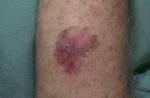


Amelanotic Melanoma
 95% of melanomas are pigmented to varying degrees. Everyone seems to fear the black mole. What about the other 5%? These are often amelanotic melanomas (those without color).
Clinically, these are among the toughest to diagnose, but also of the utmost importance. Because they are often so unimpressive to look at, they are presumed to be of little consequence, whereas in fact, they are every bit as dangerous (if not more so) than pigmented melanomas. If neglected, the patient pays an awful price. For a clinical perspective, review the photographs and see why the diagnosis is often missed. Don’t let it happen to you!
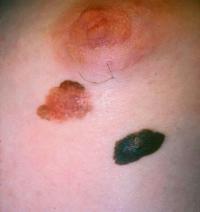 Multiple melanomas are seen in 8-12% of patients who develop melanoma. The photograph at left is of a young woman with two melanomas on her right breast at the same time. One is pigmented and the other is amelanotic. Another recent patient developed six melanomas over a period of three years. We have seen ten patients in the last five years develop another melanoma or more following their first melanoma. Any patient who has had a melanoma should be re-evaluated every three months for new lesions. We can recognize them a lot faster than the patient. Waiting creates a significant disadvantage for the patient.
It is also worth mentioning that patients with a history of breast cancer are at greater risk of developing melanoma. It would be a good idea for any cancer patient, any transplant patient or those patients on chemotherapy or immunosuppressive therapy to be evaluated by a dermatologist at six month intervals. Click here for information about visiting our offices or find a dermatologist in your area.
More pictures of amelanotic melanomas: