

|
Herpes zoster (also known as shingles) is caused by the varicella virus, the same virus that causes chicken pox
in children and young adults. The virus usually enters the body through the upper respiratory system and has an
incubation period of approximately 21 days. While the
virus is present in the bloodstream, it acts as an antigen. The body's immune system responds to the presence of the virus
and produces an antibody which effectively clears it from the blood. However, some of the virus may lie dormant in the sensory
ganglions (nerve switching centers) of the cranial or spinal nerves. Without re-exposure to the virus as the years
go by, the antibody titer falls to the point where the virus can be reactivated in these sensory ganglions. Once
the virus in a sensory ganglion is reactivated, they replicate and the viral particles descend the nerve, producing
the clinical pattern of herpes zoster (shingles) in the distribution of the sensory nerve involved.
Click here for more images of Herpes Zoster (Shingles)
Symptoms of Herpes Zoster
The initial manifestation of the infection is normally pain which may be aching, sharp, constant, or recurrent
along the course of the nerve. Patients often feel like they have pulled a muscle, slept in an unnatural position
the night before, or are developing a cold in the back. This feeling lasts for 2-7 days, and the skin becomes
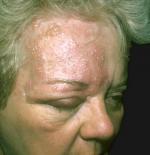
quite sensitive to touch during this period. Red patches or plaques start to appear in the involved area followed
by closely grouped papulovesicular lesions identical to lesions of chicken pox. The vesicle (blister) becomes
cloudy then purulent (pimple-like) followed by crusting and scabbing. Other than the lesions themselves, pain
or discomfort is the predominant symptom and can be quite severe. The severity of the disease course can vary
considerably, but it can be particularly unpleasant for the elderly.
Click here for more images
The virus is limited to the posterior root ganglion and the skin, because it cannot easily survive the antibodies of the bloodstream.
As long as it is confined to this location, it is very rarely contagious. However, about 5 % of patients can develop the virus in their bloodstream and
develop chicken pox lesions outside the involved skin area. When this happens, the patient becomes contagious
to others. Occasionally the body's response to the presence of the virus in the skin can be severe enough to produce
a necrosis (death of skin tissue) in the involved areas of the skin. Although not common, secondary bacterial
infection can be superimposed on the herpetic lesions.
By far, the most serious complication of herpes zoster is post herpetic neuralgia. This implies that the
sensory nerves are short-circuited and can continue to produce unpleasant pain patterns long after the clinical
skin lesions are resolved.
Treatment of Herpes Zoster
As with herpes simplex, systemic therapy is readily available, but requires early aggressive management to be
treated effectively. There are currently 5 systemic anti-viral drugs available. In addition, tricyclic antidepressants
might also be useful. They dampen extraneous nerve impulses, which significantly contribute to the establishment
of post herpetic neuralgia.
|